

Retail investors became the main force behind gold-fund buying over the past six months, helping extend bullion’s rise even as some institutional money started to step back.
At the same time, fresh inflows into US spot Bitcoin exchange-traded funds (ETFs) show part of Wall Street rebuilding crypto exposure through the regulated ETF channel, setting up a split in how investors are responding to the same backdrop of war, inflation pressure, and shifting rate expectations.
The divergence offers a clearer view of investor behavior than either market does alone. Essentially, households have leaned on gold as the traditional store of value, while professional capital has shown renewed willingness to buy Bitcoin after a weak start to the year.
The result is a market in which gold and Bitcoin are no longer moving as simple rivals for the same defensive trade, but as separate expressions of different risk appetites.
Retail takes the wheel in gold accumulation
The Bank for International Settlements laid out the shift in unusually direct terms in its March quarterly review.
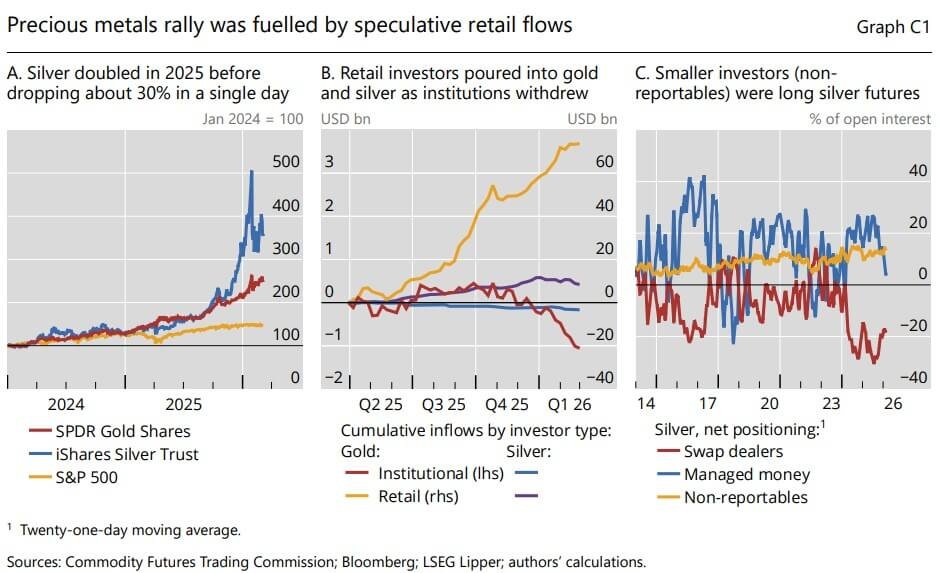
In a section on the late-January and February break in precious metals, the BIS said fund-flow data showed retail investors were the main source of inflows into gold and silver funds, while institutional investors “maintained stable positions or even trimmed exposure.”
The chart accompanying the analysis showed cumulative retail inflows into gold funds climbing to roughly $60 billion by the first quarter of 2026, up from about $20 billion in late 2025, while institutional flows stayed near flat and then turned negative.
The BIS tied the move to a broader run-up that stretched through 2025 and into early 2026. Gold and silver rose sharply before reversing in late January and February, a swing the BIS said was amplified by retail participation through ETFs, daily rebalancing by leveraged products, and margin-driven selling.
Silver, which had doubled in 2025 and then risen more than 50% in January alone, fell about 30% in a single day in late January. Gold followed the same pattern with smaller moves.
The fund-flow picture helps explain how gold continued to attract money even as prices became harder to chase.
World Gold Council data show that physically backed gold ETFs pulled in $19 billion in January, the strongest month on record, then added another $5.3 billion in February, marking a ninth straight month of inflows.
Total holdings rose to 4,171 metric tons in February, while assets under management reached a record $701 billion.
Those totals show demand remained broad, but the BIS breakdown suggests retail investors were doing more of the incremental buying.
The institutional bid starts to soften
What changed in March was not the long-run case for gold, but the willingness of some larger investors to keep adding at the same pace.
Earlier this month, investors pulled more than $4 billion from GLD, the largest gold-backed ETF. Notably, this was the largest weekly outflow in its 20 years of existence.
By a week later, spot gold had fallen rapidly to around $4,611 an ounce, its lowest level since early February.
According to goldprice.org data, this extends a seven-session losing streak as higher oil prices and inflation fears pushed expectations toward tighter monetary policy.
Higher-for-longer rates have always been a problem for bullion because gold yields nothing, and the recent slide turned that old relationship back into the main driver.
Reuters reported that analysts at Commerzbank pointed to more restrictive policy expectations as the key reason gold had come under pressure, while TD Securities said institutional positioning had grown large during the past year’s “debasement trade” and that the foundations of that trade were weakening.
In other words, gold’s buyers changed just as the macro case became harder to hold in a straight line.
Still, the institutional retreat should not be overstated.
The World Gold Council said North America added $7 billion to gold ETFs in January and another $4.7 billion in February, both part of a sustained run of inflows tied to geopolitical risk and demand for defensive assets. Europe was the weak point in February, with $1.8 billion of outflows, much of it tied to redemptions after the late-January sell-off.
This means that institutions were trimming their exposure at the margin and not abandoning the precious metal outright.
Bitcoin draws fresh money
While gold’s institutional bid began to look less certain, Bitcoin started attracting money again through the market’s main institutional access point.
Data compiled by Farside Investors show US spot Bitcoin ETFs absorbed about $1.16 billion in net inflows from March 9 through March 17. Notably, this was the strongest inflow streak since last October.
The streak included daily net additions of $246.9 million on March 10, $180.4 million on March 13, and $199.4 million on both March 16 and March 17.
However, that run paused on March 18 with a $163.5 million outflow, but the direction of travel had already been established, with BTC price reaching as high as above $75,000 during the streak.
While those ETF flows do not prove a wholesale institutional embrace of crypto, they are the clearest evidence that professional money has started moving back toward Bitcoin after months of caution.
This is further corroborated by Bitwise data, which shows that Bitcoin’s latest institutional demand extends beyond ETF inflows.
André Dragosch, Bitwise Europe’s head of research, said in a post on X that institutional demand had accelerated to its highest level since October 2025.
His one-month tally showed that Bitcoin ETPs added 34,400 BTC and treasury companies added 46,800 BTC, including 46,400 BTC from Strategy alone, for a combined 81,200 BTC.
Against a new monthly supply of about 13,300 BTC, that meant institutions bought about six times as much Bitcoin as miners produced over the same period.
Meanwhile, Coinbase’s latest institutional survey points out the institution’s strong conviction in the top crypto.
In a January survey of 351 institutional decision-makers conducted with EY-Parthenon, 74% of the respondents said they expect crypto prices to rise over the next 12 months, and 73% said they plan to increase digital-asset allocations in 2026.
The same report said the share of firms allocating more than 5% of assets under management to digital assets is expected to rise from 18% to 29% by the end of 2026.
Those figures suggest Wall Street’s return to Bitcoin is no longer visible only through the ETF wrapper. It is also showing up in corporate treasury accumulation and in survey data pointing to larger planned allocations.
What does this shift mean for gold and BTC?
The flow split suggests that gold and Bitcoin are attracting different types of buyers across different parts of the same macro trade.
Gold remains the first choice for retail investors seeking a store of value during periods of war, inflation, and interest-rate uncertainty. Its long history, deep liquidity, and lower day-to-day volatility keep it attractive to households and fund buyers seeking protection without taking on the price swings common in crypto markets.
Bitcoin, by contrast, is regaining ground with institutions willing to treat it as a scarce, liquid asset with higher upside and higher risk.
The recent pickup in ETP demand, treasury-company accumulation, and survey data pointing to larger planned allocations suggest that professional investors are becoming more comfortable adding exposure as supply conditions tighten and access improves through regulated products.
For markets, the implication is that gold and Bitcoin are no longer competing in a simple zero-sum way.
Gold can continue to attract defensive retail flows even if institutional money slows, while Bitcoin can benefit from corporate buying and portfolio reallocation even if it remains more sensitive to policy signals and liquidity conditions.
In the near term, gold looks positioned to hold its role as a hedge, while Bitcoin is increasingly trading as an institutional scarcity asset.